World Cup 2026
Geography of the 2026 World Cup: All 16 Host Cities Explained
July 2026 · 6 min read
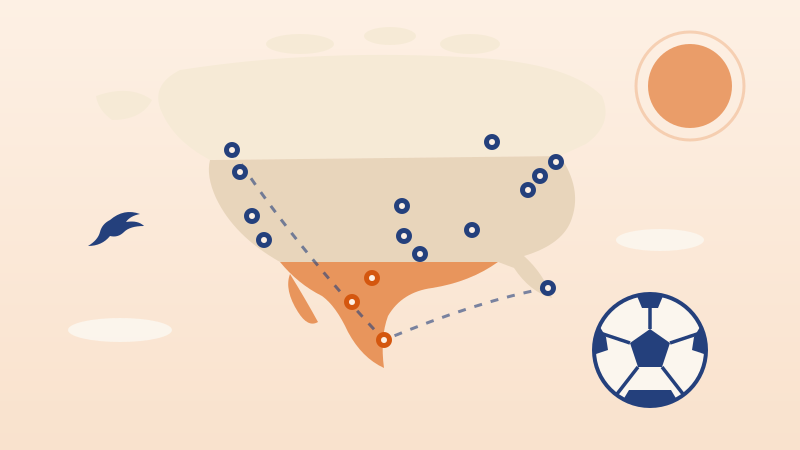
The 2026 FIFA World Cup is the biggest edition in the tournament's history — and it's also the most geographically spread out. For the first time ever, three nations are co-hosting: the United States, Mexico, and Canada. Between June 11 and July 19, 2026, a record 104 matches are being played across 16 host cities spanning roughly 4,000 kilometers from Vancouver in the northwest to Miami in the southeast.
That makes this World Cup a geography lesson in itself. Teams and fans are crossing four time zones, climbing from sea level to over 2,200 meters of altitude, and moving between rainforest-humid coastlines, high desert plateaus, and temperate Pacific shores. Here's the geographic story behind every host city.
One Tournament, One Continent, Three Countries
All 16 host cities sit in North America, but the continent's sheer size means the tournament covers more ground than any before it. The United States is hosting 78 of the 104 matches — including everything from the quarterfinals onward — while Mexico and Canada host 13 matches each.
A quick geographic note before we tour the cities: several "host cities" are actually branding for metro areas. The New York/New Jersey matches are played in East Rutherford, New Jersey; the Dallas matches in Arlington, Texas; the San Francisco Bay Area matches in Santa Clara. Geography purists, take note — it's a great trivia question in its own right.
Mexico: Football at Altitude
Mexico City
Mexico City sits in the Valley of Mexico at roughly 2,240 meters (about 7,350 feet) above sea level, ringed by volcanoes including Popocatépetl and Iztaccíhuatl. That altitude is a genuine sporting factor: the air is about 20% thinner than at sea level, which affects both player stamina and how far the ball travels.
The city's Estadio Azteca made history by hosting the opening match of this tournament, adding to its unmatched résumé — it remains the only stadium to have hosted two World Cup finals (1970 and 1986). Mexico is also now the first country to host or co-host the World Cup three times.
Guadalajara
Mexico's second-largest metropolitan area sits in the state of Jalisco on the Atemajac Valley plateau, at around 1,500 meters of elevation. Guadalajara is the cultural heartland of two of Mexico's most famous exports: mariachi music and tequila, the latter named after a town just an hour west of the city, set beneath an extinct volcano of the same name.
Monterrey
Monterrey is northern Mexico's industrial powerhouse, dramatically framed by the Sierra Madre Oriental mountain range. Its most recognizable landmark is the Cerro de la Silla ("Saddle Hill"), a saddle-shaped peak that dominates the skyline. At roughly 540 meters of elevation, Monterrey is far lower than Mexico's other two host cities — but it's often the hottest, with summer temperatures regularly pushing past 35°C.
Canada: First-Time Host
Toronto
Canada's largest city sits on the northwestern shore of Lake Ontario, the smallest of the five Great Lakes by surface area. Toronto anchors the "Golden Horseshoe," the densely populated arc wrapping around the lake's western end that holds more than a quarter of Canada's entire population. This is Canada's first time hosting or co-hosting a World Cup — and fittingly, Toronto hosted the country's first-ever home World Cup match.
Vancouver
On the opposite side of the continent, Vancouver sits where the Pacific Ocean meets the Coast Mountains in British Columbia. It's consistently one of the mildest cities in Canada thanks to the moderating effect of the ocean, making it arguably the most comfortable climate of any 2026 host city. Vancouver is also the most northwesterly host — nearly 4,000 kilometers from Miami as the crow flies.
United States: Eleven Cities, Four Time Zones
The American host cities are best understood in three regional clusters.
The East
Boston (Foxborough, Massachusetts) — The northernmost U.S. host city, in New England, with matches played about 35 kilometers southwest of Boston proper.
New York/New Jersey (East Rutherford, New Jersey) — MetLife Stadium sits in the New Jersey Meadowlands, a stretch of wetlands just across the Hudson River from Manhattan. It hosts the final on July 19 — meaning the World Cup will technically be won in New Jersey, not New York.
Philadelphia — Positioned between the Delaware and Schuylkill rivers, Philadelphia was the early capital of the United States and sits almost exactly halfway between Boston and Washington, D.C. along the busy I-95 corridor.
Atlanta — The unofficial capital of the American Southeast, Atlanta sits in the foothills of the Appalachian Mountains at about 320 meters of elevation — one of the highest major cities east of the Mississippi River. Its matches are played indoors under a retractable roof, a relief in the humid Georgia summer.
Miami (Miami Gardens, Florida) — The southernmost host city, closer to Havana, Cuba than to Atlanta. Miami sits at the edge of the Everglades on a flat coastal plain barely above sea level — the geographic opposite of Mexico City in almost every way.
The Center
Dallas (Arlington, Texas) — AT&T Stadium hosts nine matches, more than any other venue in the tournament. Arlington sits in the middle of the Dallas–Fort Worth "Metroplex" on the North Texas prairie.
Houston — Just 80 kilometers from the Gulf of Mexico, Houston is one of the most humid host cities, which is why its matches also happen under a closed, air-conditioned roof.
Kansas City, Missouri — The most centrally located host city, sitting near the confluence of the Kansas and Missouri rivers in the Great Plains. It's a few hours' drive from the geographic center of the contiguous United States.
The West
Seattle — Wedged between Puget Sound and Lake Washington, with the Cascade Range to the east and the Olympic Mountains to the west, Seattle may be the most scenically dramatic U.S. host city. On a clear day, the volcanic cone of Mount Rainier looms over the skyline.
San Francisco Bay Area (Santa Clara, California) — Matches are played in the heart of Silicon Valley, about 70 kilometers southeast of San Francisco itself, near the southern tip of San Francisco Bay.
Los Angeles (Inglewood, California) — SoFi Stadium sits on the flat Los Angeles coastal basin, hemmed in by the Pacific Ocean and ringed by the Santa Monica and San Gabriel mountains. Los Angeles is one of only two 2026 host regions that also hosted matches in the 1994 World Cup era of American soccer growth.
The Geographic Extremes of World Cup 2026
- Highest venue: Mexico City, at about 2,240 meters
- Lowest venues: Miami and Vancouver, essentially at sea level
- Northernmost: Vancouver, at about 49°N
- Southernmost: Miami, at about 25°N — a latitude span wider than the entire continent of Europe's north–south spread from Copenhagen to Athens
- Busiest venue: Arlington, Texas, with nine matches
- Most historic: Estadio Azteca, now part of its third World Cup
The tournament has already broken the all-time World Cup attendance record, passing the mark set by the USA-hosted 1994 tournament — a record that had stood for 32 years.
Test Your Knowledge
Think you could name all 16 host cities on a blank map? Or match each stadium to its country? If you can pinpoint East Rutherford, New Jersey without peeking, you're ready for the hardest difficulty setting.