Climate & Biomes
Desert vs. Tundra vs. Steppe: What's the Difference?
July 2026 · 8 min read
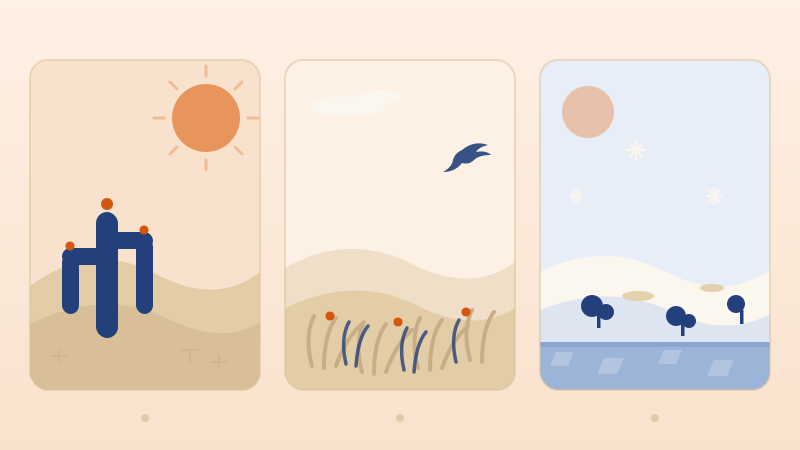
Deserts, tundra, and steppe are three of the world's great "empty-looking" landscapes — sparse, wide-open, and easy to confuse in a textbook. But they're empty for entirely different reasons. A desert lacks water. A tundra lacks warmth. A steppe lacks enough of either to grow trees, but has just enough to grow grass.
Understanding these three biomes means understanding the two ingredients that control almost all plant life on land: temperature and precipitation. Once you see how each biome sits on those two dials, telling them apart becomes straightforward — and you'll understand why they show up where they do on the map.
First, What Is a Biome?
A biome is a large-scale community of plants and animals shaped by a shared climate. Biomes aren't defined by which countries they're in or what they look like at a glance, but by their long-term patterns of temperature and rainfall, which in turn determine what can grow there.
Two measurements do most of the work:
- Precipitation — how much water arrives each year, as rain or snow.
- Temperature — not just the average, but how cold it gets and for how long, which controls the length of the growing season.
Deserts, tundra, and steppe are what you get at three different corners of that temperature-and-water space. Let's take each in turn.
Desert: Defined by Dryness
A desert is defined by one thing: a severe lack of water. The standard threshold is less than about 250 millimeters (10 inches) of precipitation per year. Notice that temperature isn't in the definition — which is why deserts come in two very different varieties.
Hot deserts like the Sahara, the Arabian, and the Australian Outback are what most people picture: scorching days, cold nights, and sand or rock. Cold deserts like the Gobi in Mongolia or the Great Basin in the United States are just as dry but bitterly cold in winter. There's even a case to be made that Antarctica is the largest desert on Earth — its interior receives almost no precipitation at all.
Why deserts form
Most of the world's great deserts sit around 30° north and south of the equator, and that's no accident. Warm, moist air rises at the equator, dumps its rain over the tropics, then flows toward the poles and descends at around 30° latitude — now dry, having already lost its moisture. This global circulation (the Hadley cell) creates permanent bands of high pressure and clear skies. Other deserts form in the rain shadows of mountain ranges, or along cool coastlines where offshore currents suppress rainfall (the Atacama in Chile, the driest place on Earth, forms this way).
Life in the desert
Desert plants and animals are specialists in water conservation: cacti storing moisture in swollen stems, deep taproots reaching hidden groundwater, nocturnal animals avoiding the daytime heat, and seeds that wait years for a single rainfall to bloom. The defining survival challenge is always the same — find and keep water.
Tundra: Defined by Cold
A tundra is defined not by dryness but by cold. It's the biome of the far north (and high mountains), where temperatures are so low for so much of the year that trees simply cannot grow. In fact, the tundra begins exactly where the forest ends — a boundary called the tree line.
Interestingly, tundra is often quite dry too — many tundra regions receive as little precipitation as deserts. But because evaporation is so low in the cold, the little moisture present stays around, often as bogs and marshes in summer.
The two kinds of tundra
- Arctic tundra rings the Arctic Ocean across northern Canada, Alaska, Scandinavia, and Siberia. Its signature feature is permafrost — ground that stays frozen year-round. In summer, only the top layer thaws, so water can't drain away, creating a soggy carpet of mosses, lichens, and dwarf shrubs.
- Alpine tundra occurs on high mountains at any latitude, even at the equator, above the tree line. It has the cold and the low-growing plants of Arctic tundra but usually lacks permafrost, because steep slopes drain the water away.
Why the tundra is treeless
Trees need a growing season long enough to produce and support wood and leaves. In the tundra, the growing season is only a few weeks, the soil is frozen or waterlogged, and biting winds dry out anything that grows tall. So life stays low and hardy: caribou and reindeer, arctic foxes and hares, migratory birds that arrive for the brief, insect-rich summer, and plants that hug the ground for warmth and shelter.
Steppe: The Grassland In Between
A steppe is a temperate grassland — too dry to be a forest, but too wet to be a desert. It sits in the middle of the precipitation range, typically receiving more than a desert but not enough (or too seasonal) to support many trees. The result is vast, rolling seas of grass.
Steppe is the Eurasian name for this biome, stretching in a great belt from Ukraine across Central Asia to Mongolia. The same biome has different regional names elsewhere: the prairies of North America, the pampas of Argentina, and the veld of South Africa are all versions of temperate grassland.
Why grass wins here
Grasses are perfectly adapted to the steppe's in-between conditions. Their growing points sit at or below the soil surface, so they survive grazing, fire, and drought that would kill a tree. They grow fast in the wet season and go dormant in the dry one. Trees, needing steadier water and deeper soil moisture, can't compete — so they're confined to river valleys, while grasses dominate the open plains.
Two features define steppe ecology: grazing animals (historically vast herds — bison on the prairies, saiga antelope and wild horses on the Eurasian steppe) and rich, deep soils. Millennia of grasses growing and decaying have created some of the most fertile topsoil on the planet, which is why the world's grasslands have so often been plowed into its greatest grain-producing regions.
The Key Differences at a Glance
| Feature | Desert | Tundra | Steppe |
|---|---|---|---|
| Limiting factor | Too little water | Too little warmth | In between — too dry for forest |
| Precipitation | Very low (<250 mm) | Low, but low evaporation | Moderate, often seasonal |
| Temperature | Hot or cold, extreme swings | Very cold, short summer | Temperate, hot summers/cold winters |
| Dominant plants | Cacti, succulents, sparse shrubs | Mosses, lichens, dwarf shrubs | Grasses |
| Trees? | Almost none | None (beyond tree line) | Very few, only near water |
| Signature feature | Aridity | Permafrost | Fertile soil, open grassland |
| Where | ~30° latitude, rain shadows | Far north, high mountains | Continental interiors, mid-latitudes |
How to Tell Them Apart
If you're trying to classify a landscape, ask two questions in order:
- Is it extremely cold with a very short growing season? If yes, it's tundra — regardless of how dry it is. Cold is the master control here.
- If it's not defined by cold, is there almost no water at all? If yes, it's desert. If there's enough water for a carpet of grass but not for forest, it's steppe.
A helpful way to remember the relationship: steppe often sits as a transition zone between desert and wetter biomes. As you travel from a desert toward a forest, you frequently pass through steppe on the way — the grassland is literally the middle ground.
Common Questions
Is the tundra a cold desert?
They're closely related — both can be very dry — but they're classified separately. The tundra's defining trait is cold and permafrost; a cold desert's defining trait is extreme aridity. A cold desert like the Gobi has more temperature range and even less biological productivity than tundra.
What's the difference between steppe and savanna?
Both are grasslands, but savanna is tropical (warm year-round, with scattered trees, like the African plains), while steppe is temperate (with cold winters and almost no trees). Temperature is the divider.
Can a place be both desert and cold?
Yes — cold deserts exist, such as the Gobi and much of the Great Basin. "Desert" refers to dryness, not heat.
Where do these biomes meet?
Central Asia is the classic showcase: you can travel from Siberian tundra in the north, through Mongolian steppe in the middle, into the Gobi desert — three biomes in one region, arranged by climate.
Which biome has the most fertile soil?
Steppe, by far. Temperate grassland soils are among the richest on Earth, which is why they've become the world's breadbaskets.
Test Your Biome Knowledge
You've sorted desert from tundra from steppe — now take on the rest. Four new Climate & Biomes quizzes cover the key vocabulary, the world's climate zones, and every major biome, from the drylands to the high alpine.