Oceans & Seas
The World's Major Ocean Currents Explained Simply
July 2026 · 8 min read
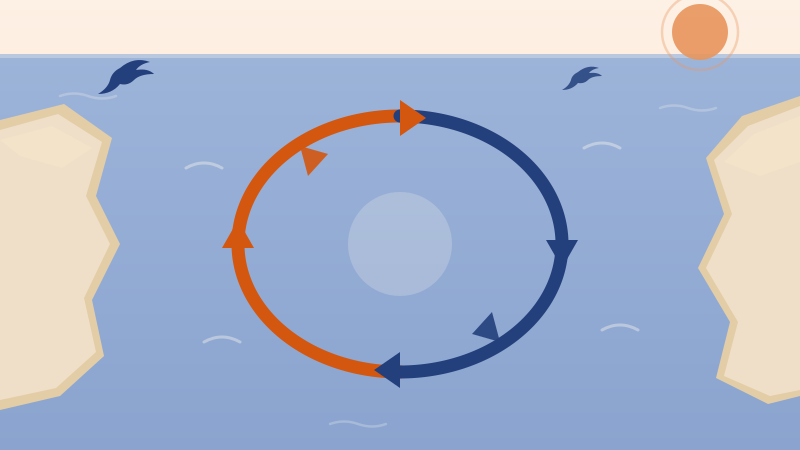
The ocean is never still. Beneath the waves, enormous rivers of water are constantly on the move, carrying warm water toward the poles and cold water back toward the equator. These are ocean currents, and they do something remarkable: they redistribute the sun's heat across the entire planet, making frozen coastlines livable, driving weather, and shaping the climate of every continent.
This guide explains, in plain terms, what drives ocean currents, the major ones worth knowing, and why they matter far beyond the beach.
What Causes Ocean Currents?
Ocean currents come in two layers, driven by two different forces.
Surface currents: driven by wind
The top few hundred meters of the ocean are pushed around by the wind. The world's prevailing winds — the trade winds near the equator, the westerlies in the mid-latitudes — drag the water's surface along with them, setting the upper ocean in motion.
But the water doesn't travel in a straight line, because of the Coriolis effect: as the Earth rotates, moving objects (including water and air) get deflected — to the right in the Northern Hemisphere, to the left in the Southern. The combination of steady winds and this deflection organizes the surface ocean into five giant circular systems called gyres, one in each major ocean basin. They spin clockwise in the north and counterclockwise in the south.
Deep currents: driven by density
Far below the wind's reach, a slower, more powerful circulation is at work, driven by differences in water density. This is called thermohaline circulation — "thermo" for heat, "haline" for salt, the two things that control how dense seawater is.
Here's the engine: near the poles, surface water gets very cold and, as sea ice forms, saltier (ice leaves its salt behind). Cold, salty water is dense, so it sinks to the ocean floor and spreads slowly toward the equator, while warmer surface water flows in to replace it. This sinking-and-spreading loop connects all the world's oceans into a single, slow-moving system sometimes called the global conveyor belt, which takes an estimated 1,000 years to complete one full circuit.
Together, wind-driven surface currents and density-driven deep currents form one interconnected global system that moves heat, nutrients, and even marine life around the world.
The Major Currents to Know
The Gulf Stream (North Atlantic)
The most famous current on Earth. The Gulf Stream carries warm water from the Gulf of Mexico up the eastern coast of North America, then veers across the Atlantic toward Europe, where its extension is called the North Atlantic Drift. It transports an astonishing amount of heat — and it's the reason Western Europe is far milder than its latitude suggests. London sits farther north than parts of Canada that freeze solid in winter, yet enjoys a temperate climate largely thanks to this current.
The Kuroshio Current (North Pacific)
Often called "the Gulf Stream of the Pacific," the Kuroshio (Japanese for "black tide") carries warm tropical water northward past Japan, warming its climate and feeding rich fishing grounds where it meets colder waters.
The Antarctic Circumpolar Current (Southern Ocean)
The largest current in the world by volume. With no continents to block it, the Antarctic Circumpolar Current flows all the way around Antarctica, connecting the Atlantic, Pacific, and Indian Oceans. It acts as a kind of moat, isolating Antarctica and keeping it frozen, and it plays a central role in the global conveyor belt.
The Humboldt (Peru) Current (South Pacific)
A cold current flowing north along the western coast of South America. The Humboldt Current carries nutrient-rich cold water up from the deep, supporting one of the most productive fisheries on the planet — and its cool, dry influence helps create the Atacama Desert onshore.
The California Current and the Canary Current
These cold currents flow toward the equator along the west coasts of North America and North Africa respectively — the return arms of their ocean gyres. Cold currents like these tend to bring cooler, foggier, drier conditions to the coastlines they touch (think San Francisco's summer fog).
Boundary currents, in general
A useful pattern: on the western side of ocean basins, currents are usually warm and flow away from the equator (Gulf Stream, Kuroshio). On the eastern side, they're usually cold and flow toward the equator (California, Humboldt, Canary). Once you know this rule, you can predict the temperature of a coastal current just from where it sits on the map.
Why Ocean Currents Matter
They control climate
Currents are the planet's central heating system. By moving warm water poleward and cold water equatorward, they moderate temperatures worldwide and prevent the tropics from overheating and the poles from freezing even harder. Coastal climates are especially shaped by whether a warm or cold current runs offshore.
They drive weather
Warm currents feed moisture and energy into the atmosphere, fueling storms and rainfall. Cold currents suppress rainfall, which is why several of the world's coastal deserts sit beside cold currents. The periodic warming of the Pacific known as El Niño — a disruption of normal current and wind patterns — can shift weather across the entire globe, causing droughts in some regions and floods in others.
They support marine life
Where currents force deep water toward the surface — a process called upwelling — they bring up nutrients that feed plankton, which feed fish, which feed everything else. The world's richest fishing grounds sit almost entirely over upwelling zones, like those of the Humboldt and Canary Currents.
They shaped human history
For centuries, sailors relied on currents (and their accompanying winds) to cross oceans. Trade routes, exploration, and the timing of voyages all followed the ocean's rivers. Even today, currents affect shipping efficiency and carry drifting objects — and, unfortunately, plastic pollution, which collects in the calm centers of the gyres.
A Simple Mental Model
If it helps, picture the ocean working on two timescales at once:
- Fast and shallow: wind pushes the surface into five great spinning gyres, warm on their western edges, cold on their eastern edges.
- Slow and deep: cold, salty water sinks at the poles and creeps along the seafloor, tying every ocean together in a thousand-year loop.
Both layers are doing the same fundamental job — moving heat from where there's too much of it (the equator) to where there's too little (the poles).
The Five Ocean Gyres
Because the gyres organize so much of the surface ocean, they're worth knowing by name. There are five major ones:
- North Atlantic Gyre — contains the Gulf Stream on its western edge and the Canary Current on its eastern edge. Its calm center is the Sargasso Sea, the only "sea" on Earth with no land borders, defined entirely by currents.
- South Atlantic Gyre — spins counterclockwise, with the warm Brazil Current on the west and the cold Benguela Current on the east.
- North Pacific Gyre — the largest, home to the Kuroshio Current and, less happily, the Great Pacific Garbage Patch, where floating plastic accumulates in the gyre's slow-moving heart.
- South Pacific Gyre — includes the East Australian Current (made famous by Finding Nemo) and the cold Humboldt Current.
- Indian Ocean Gyre — unusual because the seasonal monsoon winds reverse part of its circulation twice a year.
Each gyre follows the same warm-west, cold-east pattern described above, which is why the rule is so useful: name the ocean and the side of the basin, and you can predict the current.
Common Questions
What's the difference between a current and a tide?
A tide is the regular rise and fall of sea level caused by the moon's and sun's gravity. A current is the continuous horizontal flow of water, driven mainly by wind and density. Tides come and go; major currents flow constantly.
Why is Europe warmer than Canada at the same latitude?
The Gulf Stream and its North Atlantic extension carry warm water toward Europe, releasing heat into the air. Eastern Canada, on the other side of the Atlantic, gets cold currents flowing south instead.
What is the global conveyor belt?
A nickname for the worldwide thermohaline circulation — the deep, density-driven system that links all the oceans in a single slow loop, moving heat and nutrients over roughly a thousand-year cycle.
Can ocean currents change?
Yes. Currents shift naturally (as in El Niño years) and can be affected by longer-term changes in temperature and freshwater input. Because currents regulate climate, scientists watch them closely.
What causes upwelling?
Usually winds pushing surface water away from a coast, allowing cold, nutrient-rich water to rise from below. Upwelling zones are the ocean's most biologically productive areas.
Test Your Knowledge
Can you trace the Gulf Stream, name the current that keeps Antarctica frozen, or explain why the western edge of an ocean basin runs warmer than the eastern edge?